Showing posts with label Jeep. Show all posts

Friday, July 9, 2010

Jeep Station Wagon, 1946

Jeep Station Wagon, 1946


When it appeared in dealers' showrooms in the summer of 1946, the Jeep Station Wagon was an immediate hit. Not only was it one of the first all-new postwar vehicles to be produced, it was attractive, affordable, and perhaps most importantly, utilitarian - a vehicle appealing to the eye and the pocketbook, yet useful for a wide variety of tasks. Its compact 104-inch wheelbase allowed it to be driven and parked almost anywhere, and yet its interior provided seating for seven, with all but the driver's seat made removable for cargo-hauling. In fact, with the rear seats removed, 96 cubic feet of cargo capacity became available, and the 50-inch interior height permitted transportation of especially tall items, something unthinkable in most cars of the era. For the first time the station wagon, previously considered by many a near-luxury vehicle, was being produced as a striking, low-cost family car - and quickly accepted.

The Jeep Station Wagon was ruggedly dependable. Roos had provided a front suspension that resembled the "planar" suspension he developed for Studebaker in the Thirties; it utilized a seven-leaf transverse spring rather than conventional coil springs. The powertrain featured the Willys four-cylinder "Go-Devil" engine, augmented in the 1948 model year by a Roos-designed six-cylinder "Lightning" engine. Even more significant was the introduction of four-wheel drive models in 1949, beginning an association of that technology and cargo-carrying passenger vehicles that has been a hallmark of the Jeep brand ever since.

Correctly described as "One of the most influential automobiles ever built," the Jeep Station Wagon was produced through the early 1960s, then succeeded by the Jeep Wagoneer and subsequent Jeep sport-utility vehicles. Each of these Jeep vehicles has elevated the sport-utility concept to a higher level of comfort, performance and utility. But they all owe their success to the design of the slab-sided Jeep Station Wagon, first sketched by Brooks Stevens on a winter day in Toledo more than sixty years ago.

Jeep Panel Delivery, 1946

Jeep Panel Delivery, 1946


Jeep Panel Delivery, 1946

Monday, April 19, 2010

Jeep CJ-2A

Jeep CJ-2A, 1945


The first civilian Jeep vehicle, the CJ-2A, was produced in 1945. Willys advertisements marketed the Jeep as a work vehicle for farmers and construction workers. It came with a tailgate, side-mounted spare tire, larger headlights, an external fuel cap and many more items that its military predecessors did not include.

The CJ-2A was produced for four years, and in 1948 the CJ-3A was introduced. It was very similar to the previous model but featured a one-piece windscreen, and retained the original L-head four-cylinder engine.

Sunday, March 28, 2010

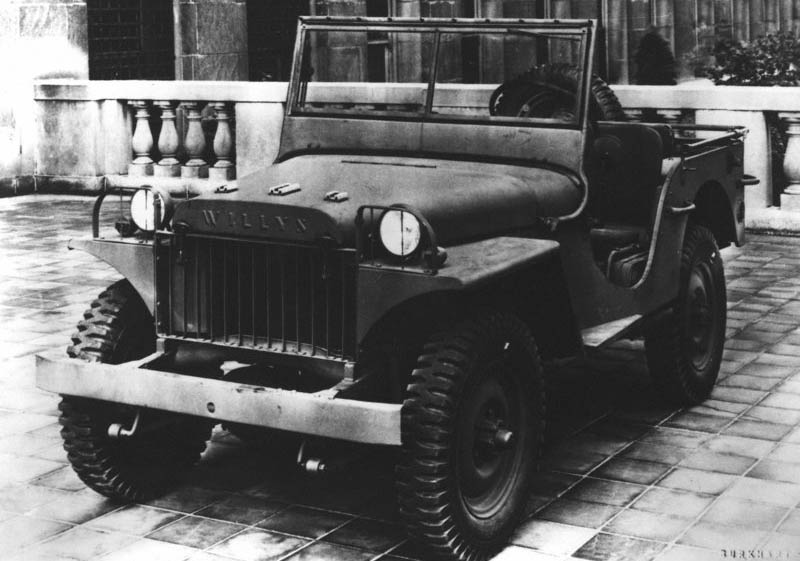
Jeep Willys MB

Jeep Willys MB 1943

With modifications and improvements, the Willys Quad became the MA, and later the MB. But the Army, and the world, came to know it as the Jeep.

Some claimed that the name came from the slurring of the letters "GP," the military abbreviation for "General Purpose." Others say the vehicle was named for a popular character named "Eugene the Jeep" in the Popeye cartoon strip. Whatever its origin, the name entered into the American lexicon and, for awhile, served almost as a generic title for off-road vehicles, while the Jeep itself became an icon of the war.

The Willys MA featured a gearshift on the steering column, low side body cutouts, two circular instrument clusters on the dashboard, and a hand brake on the left side. Willys struggled to reduce the weight to the new Army specification of 2,160 lbs. Items removed in order for the MA to reach that goal were reinstalled on the next-generation MB resulting in a final weight of approximately just 400 lbs. above the specifications.

Willys-Overland would build more than 368,000 vehicles, and Ford, under license, some 277,000, for the U.S. Army. The rugged, reliable olive-drab vehicle would forever be known for helping win a world war.

Willys trademarked the "Jeep" name after the war and planned to turn the vehicle into an off-road utility vehicle for the farm - the civilian Universal Jeep. One of Willys' slogans at the time was "The Sun Never Sets on the Mighty Jeep," and the company set about making sure the world recognized Willys as the creator of the vehicle.

Jeep Willys MA

Jeep Willys MA 1941


With modifications and improvements, the Willys Quad became the MA, and later the MB. But the Army, and the world, came to know it as the Jeep.

Some claimed that the name came from the slurring of the letters "GP," the military abbreviation for "General Purpose." Others say the vehicle was named for a popular character named "Eugene the Jeep" in the Popeye cartoon strip. Whatever its origin, the name entered into the American lexicon and, for awhile, served almost as a generic title for off-road vehicles, while the Jeep itself became an icon of the war.

The Willys MA featured a gearshift on the steering column, low side body cutouts, two circular instrument clusters on the dashboard, and a hand brake on the left side. Willys struggled to reduce the weight to the new Army specification of 2,160 lbs. Items removed in order for the MA to reach that goal were reinstalled on the next-generation MB resulting in a final weight of approximately just 400 lbs. above the specifications.

Willys-Overland would build more than 368,000 vehicles, and Ford, under license, some 277,000, for the U.S. Army. The rugged, reliable olive-drab vehicle would forever be known for helping win a world war.

Willys trademarked the "Jeep" name after the war and planned to turn the vehicle into an off-road utility vehicle for the farm - the civilian Universal Jeep. One of Willys' slogans at the time was "The Sun Never Sets on the Mighty Jeep," and the company set about making sure the world recognized Willys as the creator of the vehicle.

Jeep Wrangler Unlimited EV

Jeep Wrangler Unlimited EV 1940


The Jeep Wrangler Unlimited EV is a Range-extended Electric Vehicle that provides a glimpse into the future of a "Go Anywhere, Do Anything" vehicle with renowned Jeep Wrangler capability.

The ENVI is to develop the electric-drive solutions for every segment. An electric-drive Jeep Wrangler brings ultimate fuel efficiency and ultra-clean transportation to a market segment whose consumers want to explore the environment to the fullest.

The Jeep Wrangler Unlimited EV prototype is a two-wheel drive Wrangler. However, Chrysler's ENVI organization is exploring four-wheel-drive, in-wheel electric motors to demonstrate the full reach of the Company's advanced electric-drive technologies. When this technology is developed by ENVI, the instant high torque of the electric-drive motor and the ability to precisely control each wheel independently will result in off-road capability ideally suited for the Jeep brand, without compromising on-road capability.

The Wrangler Unlimited EV also uses an ENVI Range-extended Electric Vehicle powertrain, consisting of an electric motor, an advanced lithium-ion battery system, and a small gasoline engine with an integrated electric generator to produce additional energy to power the electric-drive system when needed. The electric motor produces 200 kW (268 horsepower) and 400 N•m (295 lb.-ft.) of torque. The Jeep Wrangler Unlimited EV has a range of 400 miles, including 40 miles of zero fuel-consumption, zero-emissions, all-electric operation.

The Jeep Wrangler Unlimited EV features a new ENVI Green Pearl exterior color, integrating full body-side "EV" graphics.