Showing posts with label Audi. Show all posts

Friday, March 11, 2011

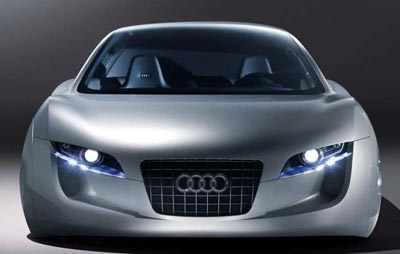
Audi RSQ Concept, 2004

Audi RSQ Concept, 2004

The Audi RSQ is a mid-engined concept car developed for use as a product placement in the 2004 sci-fi movie I Robot. It is meant to depict a technologically advanced automobile from the year 2035.

This sports coupé is a visionary interpretation of Audi's typical automobile design. An important challenge presented to the designers was that despite its extreme character the car still had to be recognized by the audience as an Audi. To accommodate this demand, the engineers implemented a current Audi front-end design that includes a single-frame grille and the company's trademark overlapping rings.

The RSQ also includes special features suggested by movie director Alex Proyas. It utilizes spheres instead of wheels and its two butterfly doors are hinged to the C-posts of the body.

Although this kind of collaboration was a first for Audi, a similar project was developed by Lexus for use in the 2002 film Minority Report

ABT Audi TT-Limited Wide Body, 2002

ABT Audi TT-Limited Wide Body, 2002

Abt TT-limited wide body. From the race track to the road.

Two well-known Abt highlights played a role in the concept of the TT-limited wide-body: the TT-Sport and the TT-limited. In the past few month, both of them have attracted many customers and even more fans. With the limited wide body, the Abt team is now showing a spectacular synthesis of its two most extreme tuning versions of the TT. Thus, the successful company from Kempten demonstrates the state-of-the-art in TT-tuning.

This becomes also clear to the average layman, who might be led to believe that the TT-limited wide-body has got lost from the race track directly on the open road. Responsible for this is the spectacular bodywork kit. As a result of extensive wind tunnel tests, the specialists from Kempten have established an aerodynamic kit, which results into more downforce and therefore a better road-holding. No matter if on local roads or on the motorway. And, of course, on the race track. For instance at the Nurburgring, where Laurent Aiello has scored two brilliant victories for the Team Abt Sportsline with the Hasseroder-yellow Abt-Audi TT-R. The limited wide body not only shares the front spoilers and the extended fenders with the race car, but also the side skirts, a rear wing and a complicated diffuser, which gives downforce at the rear. The several carbonfibre parts also add to the racy feeling.

Aerodynamics, suspension and the impressive sport braking system - all of this serves for controlling the fireworks, that the Abt-technicians are lighting underneath the bonnet. 228 kW (310 hp) are the result of a power boost, that turns the standard 165 kW (225 hp) strong engine into a racing machine. An Abt turbocharger with intercooler and exhaust system allow the standard power plant to breathe freely. A top speed of approx. 254 kph and an acceleration from 0-100 kph in approx. 5.6 seconds speak for themselves. 

Wednesday, January 19, 2011

Audi Coupe GT, 1985

Audi Coupe GT, 1985


The Audi Coupe GT was a 2-door sports car produced and sold by Audi from 1981 to 1987. The car was an attempt by Audi to offer a more affordable version of its turbocharged, all-wheel drive Quattro. The Coupe GT featured a similar body shape to the Quattro, but without the knife-edged fender flares of the more expensive car. Mechanically, the biggest changes from the Quattro to the GT were the use of a naturally aspirated 5-cylinder engine and a front-wheel drive drivetrain.

The Audi Coupe range was fitted with the quattro All Wheel Drive system from late 1984 to produce the Audi Coupe quattro, a model which was rarer than the Turbocharged Quattro mode

Audi Sport quattro S1, 1985

Audi Sport quattro S1, 1985


The Audi Sport Quattro S1 was introduced at the end of 1984 as an update to the Audi Sport Quattro. The car featured a inline 5-cylinder engine that displaced 2,110 cc (128.8 cu in) and produced an officialy quoted figure of 350 kW (480 PS/470 bhp). However, the turbocharger utilised a recirculating air system, with the aim of keeping the turbo spinning at high speed, and the actual figure was in excess of 500 bhp (373 kW/507 PS) at 8000 rpm. In addition to the improved power output, an aggressive aerodynamic kit was added that featured very distinctive wings and spoilers to the front and rear of the car to increase downforce. The weight was lightened to just 1,090 kg (2,403 lb), and now accelerate from 0-100 km/h (62 mph) in just 3.1 seconds.

Some of the cars were supplied with a "power-shift gearbox", which is said to be a forerunner of today's Direct-Shift Gearbox (DSG) technology.

The S1 proved to be an immediate success in the rally circuit, helping Walter Röhrl and Christian Geistdörfer win the 1985 San Remo Rally. A modified version of the S1, was also driven by Michèle Mouton. The S1 evolution would become the final Group B car produced by Audi, with the works team withdrawing from the Championship following the 1986 rally in Portugal.

Twenty years after the cancellation of Group B, the Sport Quattro S1 was still widely regarded as the most powerful rally car ever fielded in international competition, with the final factory machines of 1986 rated at an incredible 441 kW (600 PS/591 bhp).

In addition to Group B competition, the S1 won the 1985 Pikes Peak International Hill Climb with Michèle Mouton in the driving seat, setting a world record time in the process. This victory was repeated in 1987, this time at the hands of Walter Röhrl, and again in 1988 (Michèle Mouton) and 1989 (Bobby Unser), completing a hat-trick.

Sunday, October 10, 2010

Audi Sport quattro, 1984

Audi Sport quattro, 1984

Audi Sport quattro, 1984

The Audi Sport Quattro was a Quattro programme car developed for homologation for Group B rallying in 1984, and sold as a production car in limited numbers. It featured an all aluminium alloy 2,133 cc (130.2 cu in) (2.1 L) 20v DOHC engine slightly smaller than that of the Audi Quattro (in order to qualify for the 3-litre engine class after the scale factor applied to turbo engines). In road-going form the engine was capable of producing 225 kW (306 PS/302 bhp), with the competition cars initially producing around 331 kW (450 PS/444 bhp).

The vehicle featured a body shell composed of carbon-kevlar and boasting wider arches, wider wheels (nine inches as compared to the Ur-Quattro's optional eight inch (203 mm) wide wheel rim), the steeper windscreen rake of the Audi 80 (requested by the Audi Sport rally team drivers for improved visibility) and, most noticeably, a 320 mm (12.6 in) shorter wheelbase. This was carried out in order to improve handling potential in the face of newer, smaller competition, such as the Lancia 037 and the Peugeot 205 T16, which had been purpose-built from the start for Group B rules.

Monday, July 26, 2010

Audi Quattro, 1980

Audi Quattro, 1980


Audi Quattro, 1980

The Audi Quattro was a famous and historically significant Audi road and Rally car. It was special in that it was the first AWD Grand Tourer since 1966's Jensen FF. Officially, the model name is simply "Quattro", always with a capital "Q" (though the graphics on the car, confusingly, refer to the AWD system and use a lowercase "q").

The word "quattro" with the lowercase "q" is used to refer to either the Audi AWD system, or any AWD version of an Audi automobile. To avoid confusion, it is also commonly referred to as the Ur-Quattro (the "Ur-" prefix is a German augmentative used, in this case, to mean "original" and is also applied to the first generation of Audi's S4 and S6 sport sedans, as in "UrS4" and "UrS6").

European Distribution
Audi released the original Quattro in 1980, making it both the first car to feature Audi's quattro All Wheel Drive system (hence its name) and the first to mate quattro with a turbocharged engine. The powerplant was a 2.1 L, single overhead cam, 10 valve straight-5 originally making 160 hp (149 kW) and eventually receiving upgrades to 200 hp and then to a twin-cam setup producing 220 hp (164 kW). It is considered one of the most significant rally cars of all time, and was one of the first to take advantage of the then-recently changed rules which allowed the use of all-wheel-drive in competition racing. Many critics doubted the viability of all-wheel-drive racers, thinking them to be too heavy and complex, yet the Quattro was an instant success, winning its first rally on its first outing. It won competition after competition for the next two years.

Total road car production is around 11,000 vehicles over the period 1980-1991. The body style received very little modification during its production run, the only significant changes were made for the 1985 model year, which included a new sloping front grill, headlights, trim and badging changes. All Quattros were hand built in Germany by a dedicated crew.

North American Distribution
Sales of the Quattro in North America began with the 1983 model year and continued through 1986. Total sales in the USA was 664 units.

The Audi Sport Quattro
The Audi Sport Quattro was a Quattro program car developed for Group B rallying homologation, and sold as a production car in limited numbers - it featured a different body shell and a significantly shorter wheelbase.

Other information
The Quattro is also famous for being a career highlight of one of the pre-eminent women in rally racing, Michèle Mouton.
In 2004, Sports Car International named this car number four on the list of Top Sports Cars of the 1980s.

Wednesday, April 28, 2010

Audi 100

Audi 100, 1979


The C2 Audi 100 was launched in 1976, with crisper styling and an unusual five-cylinder engine (the first gasoline 5 in the world - Mercedes-Benz had shown the way in 1974 with their three litre Diesel 5cyl in the Mercedes-Benz C111). It was initially a 100 bhp (74 kW) engine offering "5 cylinder power and 4 cylinder economy", and later upgraded to 136 bhp (100 kW).

The Coupé was discontinued, but a five-door hatchback model, the 100 Avant, was launched as part of this generation. Two- and four-door models continued.

The 100 was sold as the Audi 5000 in the United States, in order to rebrand the car and avoid association with the C1. It was a sales success, allowing Audi to spread development costs over a much wider base than Europe-only competitors.

In 1980, the Audi 200, a plusher variant that included a turbocharged model of 170 bhp, available in 200 5E or 200 5T spec for the UK. The 5T or turbocharged model in addition of the 5E model featured heated seats, opening front quarter windows, cruise control, ski bag, green heat insulated glass, electric sunroof and elec heated mirrors.
Standard in 3 speed auto. The only options listed in the brochure were 5 speed manual transmission at no extra cost, air con and leather seating. The car was marketed in the US as the 5000 Turbo. The Audi 100/200 was succeeded by the C3 platform model in 1983, and the 200 followed one year later.

Tuesday, April 13, 2010

Audi 100

Audi 100, 1969


The Audi 100 was shown to the press on November 26, 1968. Originally denoting a power output of 100 PS, the Audi 100 was the range's largest car after the Audi brand was revived by Volkswagen in the 1960s. The C1 platform spawned several variants: the Audi 100 two- and four-door sedans, and the Audi 100 Coupé S, a stylish fastback coupé.

The C1 was sold in the US, where it distinguished itself with remarkably poor build quality.


Audi Union Type C

Audi Union Type C, 1936


Audi Union Type C, 1936

Audi Imperator

Audi Imperator, 1929


Audi Imperator, 1929